Jefferson City – The ACLU of Missouri applauds the Missouri Legislature for its work in allocating $3.6 million in funding to the Missouri Public Defender System in this year’s budget. House Bill 12 now heads to Governor Parson’s desk for final approval. The additional funding for 53 new public defenders is a long overdue step toward meeting the state’s Sixth Amendment obligations to provide an attorney for all Missourians who cannot afford one and, according to public defender officials, will end the unconstitutional use of waiting lists.

In 2017, after decades of Missouri’s Public Defender System being underfunded, understaffed, and overworked the national ACLU and ACLU of Missouri along with MacArthur Justice Center, and Orrick, Herrington & Sutcliffe filed a groundbreaking lawsuit citing the state's failure to provide adequate legal representation to tens of thousands every year. After the original case was settled, the advocates filed a second class-action case in 2019 targeting the State’s use of waiting lists to address its lack of sufficient resources. Individuals who were placed on the waiting lists faced significant delays before receiving the representation to which they are entitled. Many were forced to wait for months in jail before a public defender was available to help them contest a charge or request bail. In February, a Missouri judge found that holding those charged with crimes on waiting lists almost certainly violates both the state and federal Constitutions, but withheld a formal ruling to provide the legislature and the governor an opportunity to provide adequate funding to address the issue.

For decades, the Missouri Bar, state officials, judges, and advocates have warned that Missouri is systematically violating the constitutional right to counsel by grossly underfunding the public defender program. The use of waiting lists represent a new low point. In some cases, it took more than a year for individuals to even speak to a defense attorney. The situation throughout Missouri is dire. At times last year there were more than 2,500 individuals waiting for representation, many held pre-trial detention. For these individuals, our justice system failed- putting them at risk of losing their jobs, homes, families and even their lives due to Covid-19. Public defender officials told the legislature that 53 additional attorneys would allow them to eliminate waiting lists.

Friday’s funding approval marks a critical step toward improving legal representation across the state for low-income Missourians. However, the ball is firmly in Governor Parson’s court. The governor must not disturb this critical funding when he signs the budget or withhold appropriated funds from the program during the fiscal year. Previously, Governor Jay Nixon withheld appropriated funding from the Missouri Public Defender System, leading to further systemic violations of the right to counsel for low-income defendants across the state.

Sara Baker, Legislative and Policy Director for the ACLU of Missouri, affirmed, “We are pleased to see the body come together in historic fashion to protect all Missourians’ right to timely and competent counsel no matter their income status. The injustice we have seen due to decades of underfunding by our elected officials has been a stain on our state's criminal legal system and legislature.”

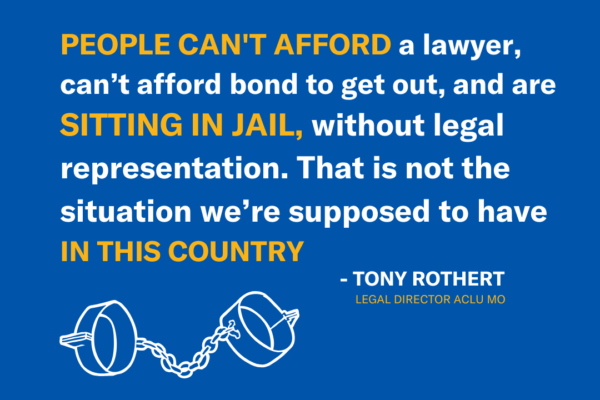
Tony Rothert, ACLU of Missouri Legal Director added, “The rights to representation and a speedy trial when the government tries to take away your freedom are fundamental to the concept of liberty that makes our country different. The legislature’s action does not change the reality that today the right of Missourians to an attorney is routinely ignored, but the promised elimination of wait lists is the first real step in decades to providing equitable justice for Missourians.”


Related Content

News & Commentary
Mar 09, 2017
Placeholder image

ACLU Sues Missouri Over Failing Public Defender System

ST. LOUIS — The American Civil Liberties Union, the ACLU of Missouri, the Roderick and Solange MacArthur Justice Center at St. Louis, and Orrick, Herrington & Sutcliffe filed a class-action lawsuit against the state of Missouri over its unconstitutional system of public defense.The state’s public defenders don’t have the time or resources to provide adequate legal representation and are unable to talk to their clients about possible witnesses, exculpatory evidence, plea negotiations, or trial strategy. The suit asks that the court force the state to improve the public defender system and end its violations of the Sixth Amendment.“I sat in jail for 42 days before I saw my public defender, who told me that I had a winnable case, but he wouldn’t have time to go to trial for another four to six months,” said Shondel Church, the lead plaintiff in the lawsuit, who was charged with felony theft but pled guilty to a misdemeanor in Kansas City in July 2016. “In jail, you’re starving on what they give you and you’re dying to get out. I was hoping things would move faster – but those 129 days cost me a whole lot: I lost all that time working, and I finally had to give up and plead guilty, just to get out and help my family.”Each year, the Missouri State Public Defender office has more than 80,000 cases. It employs approximately 370 attorneys. In 97% of their cases, Missouri public defenders fail to reach the minimum number of work hours required for constitutional representation, according to analysis by the American Bar Association and lawyers across the state.“For three decades, the state of Missouri has known about the failings of its public defense system,” said Anthony Rothert, Legal Director at the ACLU of Missouri. “This chronic underfunding has resulted in an equally chronic constitutional crisis in Missouri that has cost the livelihood of thousands of Missourians who are denied justice because their attorneys couldn’t devote the necessary time or resources to their cases.”Plaintiffs in this lawsuit have had to go before a judge for bail hearings without their public defender present. As a result, they faced bail amounts too high for them to afford and spent weeks or months in jail unnecessarily. While in jail, they have waited for weeks to see their public defenders for short conversations that are too brief to cover the relevant facts of the case.“Enough is enough with appointing commissions and committees to ‘study’ the issues. It has long been clear the state of Missouri is in a constitutional crisis,” said Mae Quinn, Director of the Roderick and Solange MacArthur Justice Center at St. Louis. “The time is now for our state to take seriously its duty to meet the standards of representation and to stop denying Missourians justice.”Said Jason Williamson, Senior Staff Attorney with the ACLU’s Criminal Law Reform Project, “Only because they can’t afford the cost of a private attorney, Missourians are stripped of their chance for a fair shake in court. This isn’t a matter of guilt or innocence. When the state’s public defense system is shortchanged, the entire criminal justice system falters.”“Missourians charged with crimes must be able to rely on the justice system for a fair outcome,” said Robert Sills, a partner at Orrick, Herrington & Sutcliffe. “But if they’re too poor to afford a lawyer, and have to rely on Missouri’s overworked and underfunded public defenders, they face added obstacles to justice, for no reason other than the size of their wallets.”
News & Commentary
Feb 19, 2021
Placeholder image

Court Rules Missouri’s Waiting List for Public Defender Violate Constitutional Right to Counsel

Judge Gives Legislature Four Months to Fix the Problem
News & Commentary
May 17, 2018
justice

Lack of Adequate Funding Forces Missouri Public Defenders to Shortchange Constitutional Rights

As the Missouri legislature ended its 2018 session, one of the last items on the docket was the state budget for next year.
Court Case
Feb 28, 2020
public defender waiting list

David v. Missouri Public Defender Commission

Groundbreaking Law Suit Targets State of Missouri for Unconstitutional Public Defender Waiting Lists. Challenges practice that has forced thousands throughout to navigate criminal legal process without counsel